
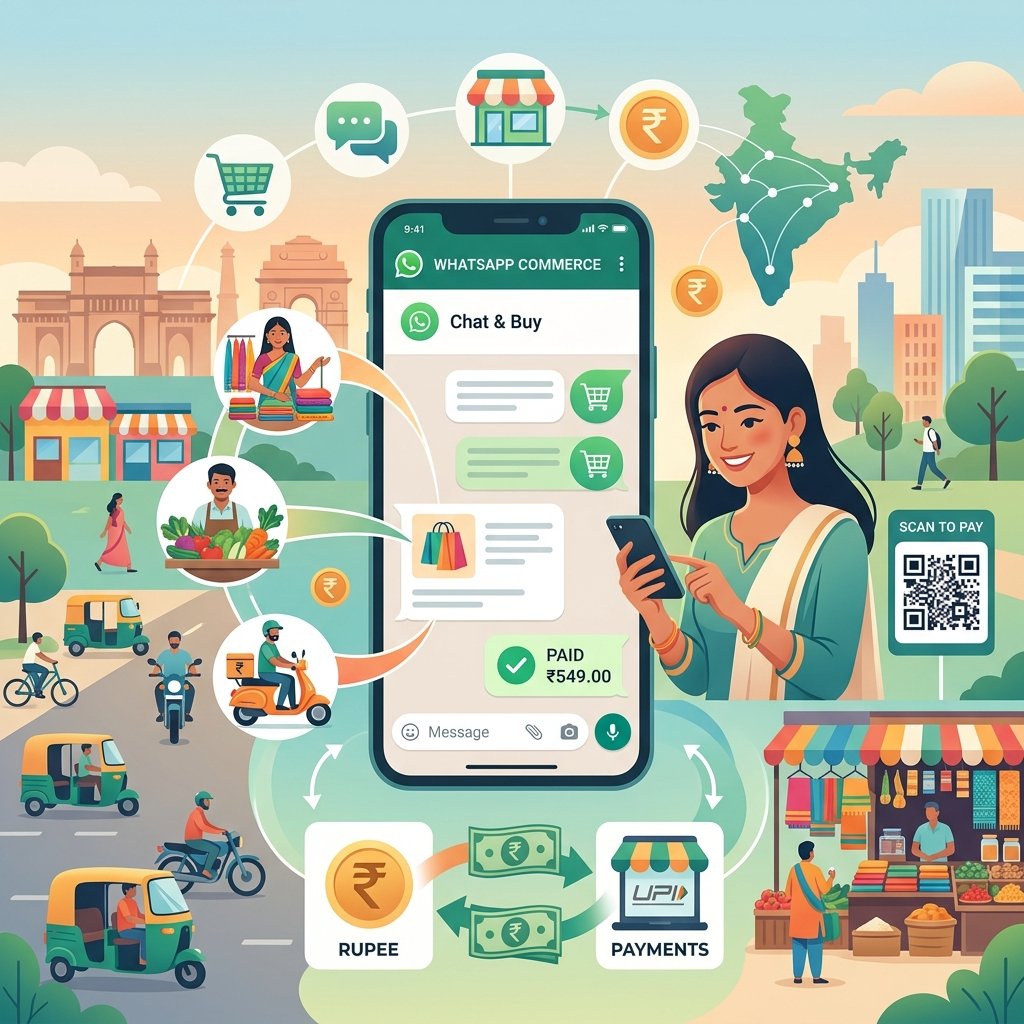
What is WhatsApp Commerce in India?
WhatsApp Commerce in India is the complete buying and selling journey — from product discovery and sizing questions to payment in the chat and Shiprocket shipping — conducted entirely inside WhatsApp conversations without forcing shoppers to visit an external website.
Your buyers already chat on WhatsApp every day. That's why WhatsApp commerce isn't just an alternative marketing channel for Indian D2C brands — it IS the primary sales channel.
If you're an Indian D2C brand in 2026, building a Shopify store and pouring lakhs into Facebook ads hoping a small share of visitors convert is the old playbook. The new playbook? Meeting your customers where they already spend their day: WhatsApp.
In this definitive guide, we'll break down exactly what WhatsApp commerce is, why it's exploding in India, the tools you need, and the playbook to stop losing orders in DMs and scale on a dedicated WhatsApp commerce platform.
Table of Contents
- What is WhatsApp Commerce?
- Why WhatsApp Fits Indian Shoppers
- The 4 Types of WhatsApp Commerce (with pros/cons)
- WhatsApp Business App vs Business API vs Store Platforms
- How to Set Up a WhatsApp Store (Step by Step)
- The Full Tech Stack for WhatsApp Commerce
- WhatsApp Commerce Playbook: Traffic → Chat → Sale
- What to Measure by Category
- Metrics to Track
- WhatsApp Commerce vs Instagram DMs vs Marketplaces
- Common Mistakes (and How to Avoid Them)
- What's Next: AI Sales Agents on WhatsApp
- FAQ
1. What is WhatsApp Commerce?
WhatsApp Commerce is the buying and selling of goods or services directly within the WhatsApp application. Instead of browsing a website, adding items to a cart, and checking out on a separate domain, the entire shopping journey, from product discovery and Q&A to payment and shipping updates, happens inside a chat thread.
While the concept started with manual WhatsApp Catalogs, it has rapidly evolved. Today, with the WhatsApp Business API and tools like Behaf, the experience is fully automated. Customers can open your store link, chat with an AI sales agent, pay securely via UPI, and receive tracking links without ever leaving the app.
2. Why WhatsApp Fits Indian Shoppers
There's a deep cultural fit. Indians have always shopped via conversation, from the local kirana store to the family jeweller. Conversational commerce simply digitizes this deeply ingrained behaviour.
3. The 4 Types of WhatsApp Commerce
Not all WhatsApp selling is created equal. There are four distinct tiers of maturity:
- Type 1: WhatsApp Business App catalog (manual) - Great for local shops. You upload products manually, but you have to collect payments via individual UPI links and book shipping yourself.
- Type 2: WhatsApp Business API + chatbot (semi-automated) - You connect the API through a provider and build reply flows yourself (press 1 for shipping, press 2 for returns).
- Type 3: Third-party stores linked from WhatsApp - You use WhatsApp as a marketing channel to drive traffic to your Shopify or Dukaan store.
- Type 4: AI sales engine INSIDE WhatsApp - The Behaf model. A true AI acts as your 24/7 sales agent, closing orders, collecting payments, and booking shipping automatically without a website.
4. WhatsApp Business App vs Business API vs Store Platforms
Choosing the right tech depends on your scale. Read our detailed breakdowns: Behaf vs Interakt and Behaf vs WATI. If you have a massive enterprise team, an API CRM might work. If you want automation without the overhead, a Store Platform may fit better.
5. How to Set Up a WhatsApp Store (Step by Step)
On Behaf there is no API application:
- Sign up for Behaf: Your store runs on Behaf's verified WhatsApp number, so there is no Meta setup.
- Upload your catalog: Add product images, descriptions, and prices.
- Add your bank account: PayU payments and Shiprocket pickup are built in, and payouts reach your bank account 7 days after each prepaid order.
- Your brand voice: Behaf sets Aria up in your brand's voice with you.
- Share: Put your store link in your Instagram bio. Behaf opens to sellers in a few weeks.
Don't want to build a website? Read our guide on How to Sell on WhatsApp Without a Website.
Starting with the free WhatsApp Business app instead? Follow the full step-by-step guide to setting up a WhatsApp shop in India: catalog, UPI and COD, shipping, and when to move beyond the app.
6. The Full Tech Stack for WhatsApp Commerce
To scale, you need a tight stack:
- Storefront: Behaf (or Shopify if you prefer traditional web).
- Payments: PayU (built into Behaf).
- Shipping: Shiprocket.
- Payouts: Payouts reach your bank account 7 days after each prepaid order.
Learn more about How Behaf Automates Payments & Shipping.
7. WhatsApp Commerce Playbook: Traffic → Chat → Sale
Success requires mastering the funnel:
- Traffic: Run Click-to-WhatsApp ads on Facebook and Instagram. Use QR codes on your packaging.
- Chat: Use AI to answer questions day or night. Speed is everything. If a customer asks "do you have this in blue?" and you reply 4 hours later, the sale is gone.
- Sale: Collect payment directly in the chat. Never make the customer switch apps.
- Retention: Use WhatsApp broadcasts to announce new drops to past buyers.
8. What to Measure by Category
Each category has one or two numbers worth watching from your first week:
- Fashion Brands: Time to answer a sizing question, and how many size questions end in an order.
- Jewellery Brands: How many chats ask about purity or hallmarking, and the share of high-ticket orders paid by UPI versus COD.
- Health & Wellness: Which ingredient questions come up most, and how many first-time buyers reorder.
- Food & Lifestyle: Repeat order rate and average days between orders.
9. Metrics to Track
Stop obsessing over website bounce rates. For WhatsApp, track:
- Chat-to-sale conversion rate
- Average order value (AOV)
- Response time (an AI agent answers day or night)
- Repeat purchase rate
10. WhatsApp Commerce vs Instagram DMs vs Marketplaces
Instagram is great for discovery. WhatsApp is where the sale can close: you own the customer relationship, buyers can ask before they pay, and the fees are low. See our guide: Pay Only When You Sell.
11. Common Mistakes (and How to Avoid Them)
The biggest mistake D2C founders make is treating WhatsApp as just a customer support channel instead of a primary sales channel. Other mistakes include trying to answer every DM manually, not offering native UPI payments, and not confirming COD orders before dispatch.
12. What's Next: AI Sales Agents on WhatsApp
The future of commerce isn't just about optimizing checkout pages. The future is an AI that acts as your top in-store sales associate, available 24/7, answering questions in the buyer's language (English, Hindi, Hinglish, Tamil or other Indian languages), recommending products, handling objections, and closing deals inside the chat interface while you sleep. Read our dedicated playbook: AI Sales Agent for D2C Brands.