Direct Verdict: Behaf vs Dukaan in 2026
Choose Behaf if you are an Indian direct-to-consumer (D2C) brand acquiring buyers via Instagram, Meta ads, or influencer collaborations and want to close sales inside WhatsApp with an autonomous AI sales agent, 1-tap UPI, and ₹0 monthly SaaS fees.
Choose Dukaan if your core objective is building a traditional, multi-page standalone desktop/mobile website with hundreds of static SKU pages and you do not rely on conversational selling, in-chat payments, or social chat traffic.
The Core Architectural Divide: Conversational Commerce vs Web Storefront
When evaluating Behaf against Dukaan, Indian D2C founders often assume they are comparing two identical ecommerce builders. In reality, they represent two fundamentally opposing philosophies of digital commerce in the Indian market:
Behaf: Conversational-First Engine
Built exclusively for the Indian consumer who lives on WhatsApp. Instead of forcing shoppers to navigate an external browser, Behaf executes the entire shopping lifecycle inside WhatsApp:
- Catalog browsing via frictionless in-chat webviews.
- Instant AI objection handling and sizing consultations.
- 1-tap UPI payment deep links (PhonePe, GPay, Paytm).
- Automated COD OTP confirmation & Shiprocket tracking.
Dukaan: Traditional Web Storefront
Originating as a digital catalog tool for local retailers, Dukaan evolved into a direct Shopify competitor focusing on fast-loading web pages and themes.
- Generates a standalone web store on your custom domain.
- Requires shoppers to navigate web menus and cart pages.
- Relies on standard web payment redirects and bank OTPs.
- WhatsApp is treated solely as an external notification add-on.
The Cultural Psychology of Indian Shoppers: Why Web Checkouts Fail
To understand why conversational commerce converts at 3x to 5x higher rates than Dukaan web stores, you must examine how everyday Indian shoppers behave on their mobile devices:
- The Need for Reassurance ("Bhaiya, will it reach before Saturday?"): In Western markets, consumers check out silently on web pages. In India, buying is inherently relational. Shoppers want to know if the fabric shrinks, whether the colour matches the photo, or if express delivery is possible. On a Dukaan website, there is nobody to ask; the visitor bounces. On Behaf, our 24/7 AI sales agent answers immediately in natural English or Hinglish.
- Typing Fatigue on Mobile Keyboards: A Dukaan web checkout asks a mobile user to type their full name, email address, postal code, apartment number, and landmark. On a 6-inch phone screen while commuting, this creates immense cognitive friction. On WhatsApp, Behaf extracts shipping details automatically from chat context and customer history with one tap.
- The App-Switching Penalty: When a shopper clicks an Instagram ad pointing to a website, Instagram's in-app browser opens. When they proceed to checkout, the browser redirects to a bank gateway, prompting an SMS OTP. If the user minimizes the browser to check their SMS app, Instagram's webview often crashes or resets the cart. In WhatsApp, the user never leaves their home communication app.
The Real Cost Analysis: Hidden Fees & Total Cost of Ownership (TCO)
Most founders look only at advertised headline subscription prices. Let's analyze what running a business on Dukaan actually costs when you assemble the tools required to sell effectively, compared to Behaf's unified engine:
| Cost Element | Dukaan Platform Stack | Behaf Commerce Platform |
|---|---|---|
| Monthly Base Software Subscription | ₹2,499 – ₹4,999 / month (Billed annually or higher monthly) | ₹0 / month (Pay only when you sell) |
| WhatsApp Business API & CRM Add-on | ₹2,500 – ₹6,000 / month (Requires Wati or Interakt plugin) | ₹0 / month (Native Meta Cloud API integration) |
| COD Verification & Fraud OTP Plugin | ₹1,500 – ₹3,000 / month | ₹0 / month (Built-in automated OTP verification) |
| Autonomous AI Sales Agent | Not available (Basic rule bot only) | Included natively 24/7 |
| Payment Gateway Processing Fees | 1.9% – 2.5% + GST (Dukaan Pay or Razorpay) | Standard Razorpay/Cashfree rate or direct UPI |
| Estimated Fixed Monthly Overhead | ₹6,500 – ₹14,000 / month | ₹0 Fixed Retainer |
For an early-stage or scaling Indian D2C brand doing ₹3 Lakh to ₹10 Lakh in monthly revenue, committing to ₹10,000+ in fixed monthly software costs before generating a sale puts immense pressure on working capital. Behaf's growth-aligned model eliminates fixed financial risk entirely.
Real Unit Economics: The ₹10 Lakh/Month Scale Test
Let's look at what happens when an Indian lifestyle or ethnic brand scales to 1,000 orders per month (₹1,000 average order value, ₹10,00,000 gross merchandise value):
| Metric at 1,000 Orders/Month | Dukaan Store + App Stack | Behaf Commerce Platform |
|---|---|---|
| Monthly Ad Spend (CAC) | ₹2,80,000 (Website conversion ads) | ₹1,75,000 (Click-to-WhatsApp ads) |
| Software Fixed Retainers | ₹11,500 / month | ₹0 / month |
| COD Orders (65% of Total) | 650 orders | 650 orders |
| COD RTO Rate & Losses (₹180/return) | 32% RTO (208 returns = ₹37,440 loss) | 11% RTO (71 returns = ₹12,780 loss) |
| Support Team Overhead | ₹30,000 (2 manual chat agents) | ₹0 (Handled 24/7 by AI agent) |
| Total Operational Cost | ₹3,58,940 / month | ₹2,37,780 / month (₹1.21 Lakh Net Profit Gain) |
The Funnel Breakdown: What Happens When an Instagram Ad Is Clicked?
Customer acquisition cost (CAC) in India is higher than ever. Here is what happens when a shopper clicks your Instagram advertisement on both platforms:
The 7-Step Dukaan Web Funnel (Friction-Heavy)
- Shopper clicks Instagram Ad → Browser window attempts to launch external website.
- Page loads slowly on mobile network; 30% bounce during initial render.
- Shopper scrolls product page, hesitates on sizing or fabric, but finds nobody to answer questions.
- Clicks "Add to Cart" → Forced to type full name, delivery address, postal pin code, and email.
- Redirected to payment gateway → Waits for bank OTP via SMS.
- If SMS is delayed by 15 seconds, shopper closes the tab and order is lost.
- Resulting Conversion Rate: 1.5% to 2.8%.
The 2-Tap Behaf Conversational Funnel (Friction-Free)
- Shopper taps Click-to-WhatsApp (CTWA) Ad → WhatsApp opens instantly with zero loading delay.
- Customer asks: "Is this available in size M for delivery to Pune?".
- Behaf's autonomous AI sales agent confirms stock, shares a quick video demo, and provides exact delivery estimates.
- Shopper taps "Buy Now" → In-chat webview opens with address pre-filled from customer history.
- Customer taps "Pay via UPI" → PhonePe / Google Pay opens with pre-filled amount. PIN entered. Done.
- Order confirmation, GST invoice, and live Shiprocket tracking dispatched in chat automatically.
- Resulting Conversion Rate: 14% to 22% (Up to 5x higher).
Category Deep-Dives: Where Behaf Dramatically Outperforms Dukaan
Fashion, Sarees & Streetwear
Fashion shoppers have complex sizing and styling doubts. On Dukaan, if a buyer cannot visualize the drape or verify blouse piece dimensions, they abandon. On Behaf, our AI agent shares exact model measurements, fabric close-up clips, and cross-sells matching dupattas in real time.
Jewellery & Luxury Crafts
High-ticket jewellery requires authentic human-like touch. Behaf provides instant certificate sharing, customization requests (ring sizes, gold polish type), and pre-paid incentives that eliminate COD risks on high-value orders.
Gourmet Sweets, Spices & Snacks
Food founders thrive on weekly re-orders. While Dukaan stores require buyers to re-visit the web URL and re-enter addresses, Behaf sends automated WhatsApp re-stock nudges with a 1-tap UPI re-order link.
Ayurveda & Wellness Supplements
Supplements require dosage clarity and regimen building. Behaf's AI conducts an automated health assessment in chat and suggests complete 30-day or 90-day bundles with personalized instructions.
Feature-by-Feature Comparison Matrix
| Feature / Capability | Behaf | Dukaan |
|---|---|---|
| Primary Checkout Destination | Native Inside WhatsApp | External Web Browser |
| 1-Tap UPI Intent Flow | Deep linked (PhonePe/GPay/CRED) | Standard Web Gateway Redirect |
| 24/7 AI Sales Agent | Autonomous (English & Hinglish) | Not available (Basic routing) |
| Abandoned Cart Recovery | Instant WhatsApp nudge (42% recovery) | SMS / Email alerts (sub-5% recovery) |
| COD Fraud & RTO Protection | Automated In-Chat OTP Verification | Requires add-on plugins |
| Courier Shipping Sync | Automatic Shiprocket / Delhivery AWB | Dukaan Delivery / Custom Couriers |
| Standalone Website Builder & Themes | Streamlined Webview Store | Full Theme Library & Plugins |
| Monthly Fixed Subscription | ₹0 / month (Pay on sale) | ₹999 – ₹4,999 / month |
Step-by-Step Migration Guide: Moving from Dukaan to Behaf in 10 Minutes
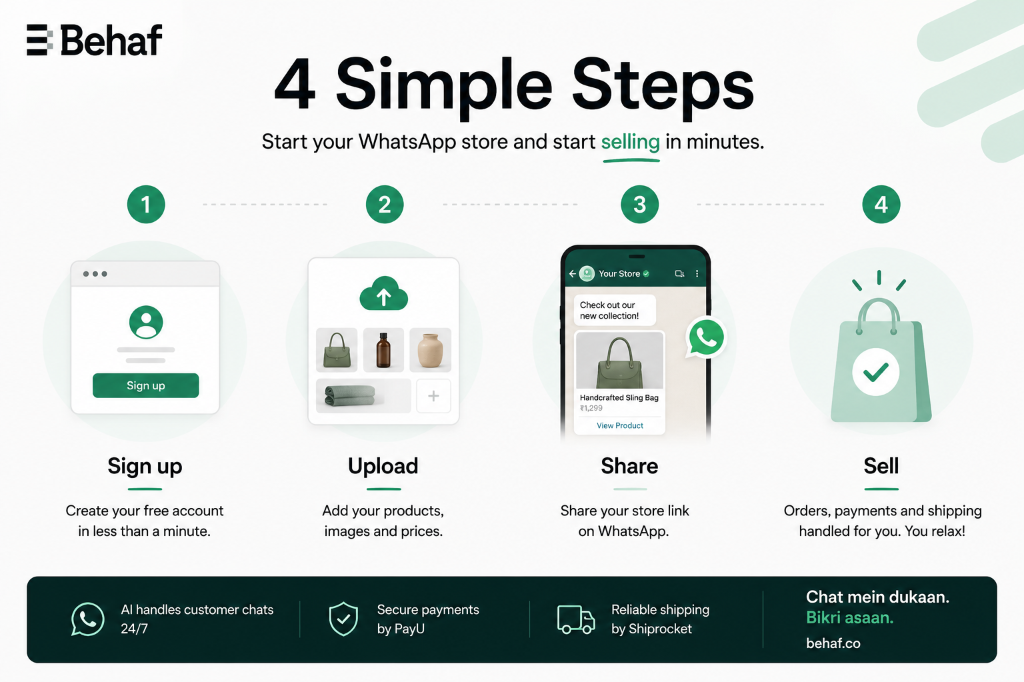
If you're currently paying for Dukaan and seeing poor mobile conversion rates, migrating to Behaf requires zero coding and zero downtime:
Step 1: Export Products from Dukaan
Log into your Dukaan dashboard, navigate to Products > Export CSV, and download your entire catalog including variants, pricing, and image URLs.
Step 2: 1-Click Import into Behaf
Upload your Dukaan CSV into the Behaf dashboard. Our importer automatically maps product titles, prices, descriptions, and high-resolution photos into your WhatsApp catalog.
Step 3: Connect WhatsApp Business API
Link your business phone number via Meta's Embedded Sign-up. Behaf handles all webhook routing, message templates, and official Cloud API compliance.
Step 4: Update Your Marketing Touchpoints
Replace your old Dukaan website URL with your new Behaf WhatsApp store link across your Instagram Bio, WhatsApp Status, and Meta ad conversion campaigns.
Frequently Asked Questions
The core difference lies in the customer journey: Dukaan is a web storefront builder that directs shoppers to an external mobile website where they browse and checkout on a browser. Behaf is a WhatsApp-first conversational commerce engine where product browsing, AI sales consultations, 1-tap UPI payments, and courier dispatch occur natively within WhatsApp chats.
No. While Dukaan can send automated WhatsApp notifications (order placed, out for delivery), the actual purchasing and checkout processes must happen on an external web browser page. Customers cannot complete 1-tap UPI checkout or interact with a catalog natively within the chat.
For conversational sellers and social commerce brands, Behaf is significantly more cost-effective. Dukaan charges monthly SaaS subscription retainers (₹999 to ₹4,999/month) plus plugin costs. Behaf charges ₹0 monthly fixed retainers, allowing brands to pay only when they generate confirmed sales.
Yes. You can export your product catalog from Dukaan as a CSV file and import it into Behaf in under 5 minutes. All variants, images, pricing, and descriptions are automatically formatted into an interactive WhatsApp catalog.
Dukaan relies primarily on SMS and email nudges or third-party WhatsApp add-ons, which typically achieve a 3% to 6% cart recovery rate. Behaf triggers personalized WhatsApp cart recovery messages with 1-tap checkout buttons, averaging 38% to 45% recovery rates because 98% of WhatsApp messages in India are opened within 15 minutes.
Yes. Behaf includes automated WhatsApp OTP verification for all COD orders natively, dropping RTO rates from the industry average of 35% down to under 12%. On Dukaan, advanced COD fraud protection requires third-party plugins or manual verification calls.
Yes. Behaf includes an autonomous 24/7 AI sales agent trained on your brand voice, sizing charts, and catalog rules that answers sizing, fabric, delivery, and discount questions in English and Hinglish. Dukaan provides basic chatbot routing but lacks autonomous consultative selling agents.
Yes, Behaf allows brands to connect their custom domain (e.g., shop.yourbrand.com) for webview catalog views, while directing all traffic, high-intent conversations, and checkouts through your verified WhatsApp channel.
Switch to Behaf: Convert 3x More Shoppers on WhatsApp
Stop losing mobile visitors to slow website checkouts. Start selling directly in DMs with Behaf's autonomous AI sales engine. Pay only when you sell.